
Trending in Mádé Kuti’s World




Story
Quick Facts
Born
1995
1995
From
Nigeria
Nigeria
Journey
Mádé Kuti, born Ọmọ́rìnmádé Aníkúlápó Kuti, is a Nigerian Afrobeat musician, multi-instrumentalist, composer, arranger, and performer. He is the son of Femi Kuti and grandson of Afrobeat pioneer Fela Kuti, placing him within one of Nigeria’s most influential musical families. Raised around the New Afrika Shrine in Lagos, Mádé encountered live performance and Afrobeat from childhood and began playing instruments at an early age. He later joined his father’s Positive Force band, performing on bass and saxophone and touring internationally while still young.
Mádé subsequently studied at London’s Trinity Laban Conservatoire, the same institution associated with his grandfather’s period of study. His musical training expanded his command of several instruments, including saxophone, trumpet, bass and piano, while giving him a formal foundation for composition and arrangement. Rather than simply reproducing the family tradition, he developed an approach that places Afrobeat within a broader musical vocabulary, incorporating elements of jazz, funk, blues and psychedelic music.
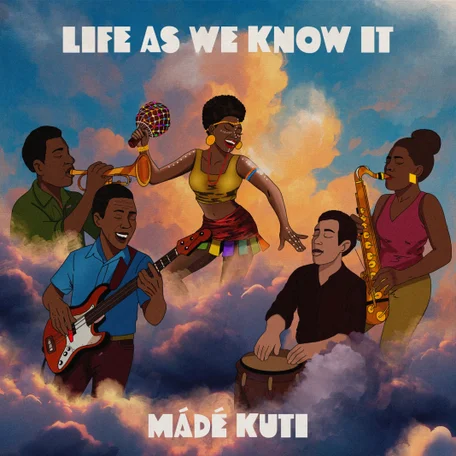
His recording career moved into focus with "For(e)ward," released on February 5, 2021. The album formed one half of "Legacy +," a joint double-album project with Femi Kuti’s "Stop the Hate." Mádé performed all the instrumentation on "For(e)ward," while contributing bass, alto saxophone and percussion to his father’s album. His writing addresses political and social concerns including police brutality, inequality, corruption, civic responsibility and personal freedom, while also making room for intimate subjects.
"Legacy +" earned Mádé and Femi a nomination for Best Global Music Album at the 64th Annual Grammy Awards in 2022, giving Mádé his first Grammy nomination.
In 2025, Mádé expanded his catalogue with "Chapter 1: Where Does Happiness Come From?," his first standalone album. Released on July 25, 2025, the 13-track project examines self-awareness, personal growth, resilience, identity and the search for happiness. Songs including “I Won’t Run Away,” “Wait and See,” “My Voice,” and “Story” reflect a more introspective side of his songwriting while retaining his commitment to socially conscious Afrobeat.
Mádé Kuti’s work occupies a position between inheritance and individual authorship. His music acknowledges the political and musical foundations established by Fela and developed by Femi, while using his own formal training, instrumental range and reflective songwriting to extend Afrobeat into a new generation.